
Why Antibody–Oligonucleotide Conjugates Are Gaining Momentum
Therapeutic oligonucleotides are opening new possibilities for treating diseases that have historically been difficult to address. However, delivering these molecules to the right cells remains one of the field’s greatest challenges. Antibody–oligonucleotide conjugates (AOCs) have emerged as one strategy to overcome this barrier by combining targeted delivery with the diverse biological activities of therapeutic oligonucleotides.
Introduction
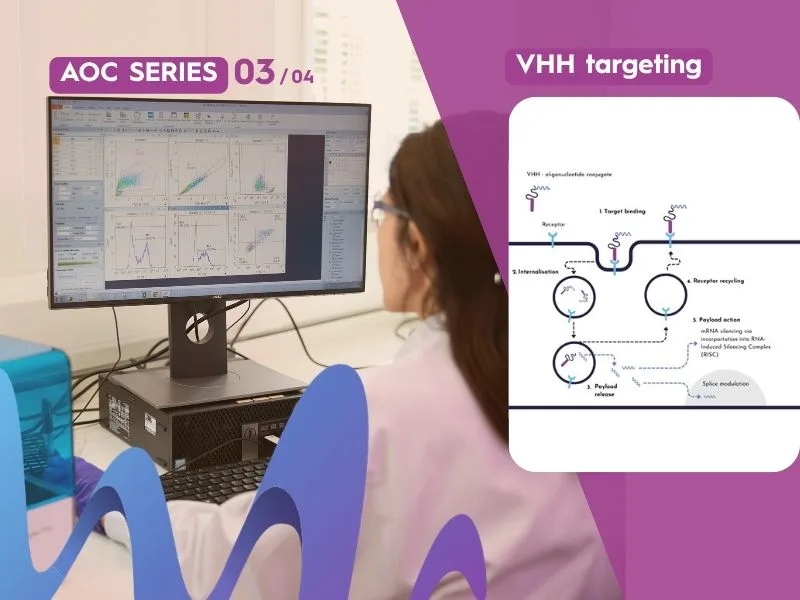
AOCs combine an antibody (or antibody fragment) with a therapeutic oligonucleotide, into a single conjugated molecule. Depending on the payload, AOCs can modulate gene expression, influence RNA processing, or activate intracellular immune pathways. The targeting ligand binds a specific cell- surface receptor, triggering receptor-mediated endocytosis and intracellular trafficking of the conjugate. Following intracellular processing, the oligonucleotide engages its molecular target to exert its therapeutic effect (1).
In practice, AOCs offer a strategy for delivering therapeutic oligonucleotides to extrahepatic tissues, such as skeletal muscle, heart, and brain, where established delivery approaches including lipid nanoparticles (LNPs) and liver-targeting GalNAc conjugates, have had limited success (2).

Unmet medical needs and modality convergence
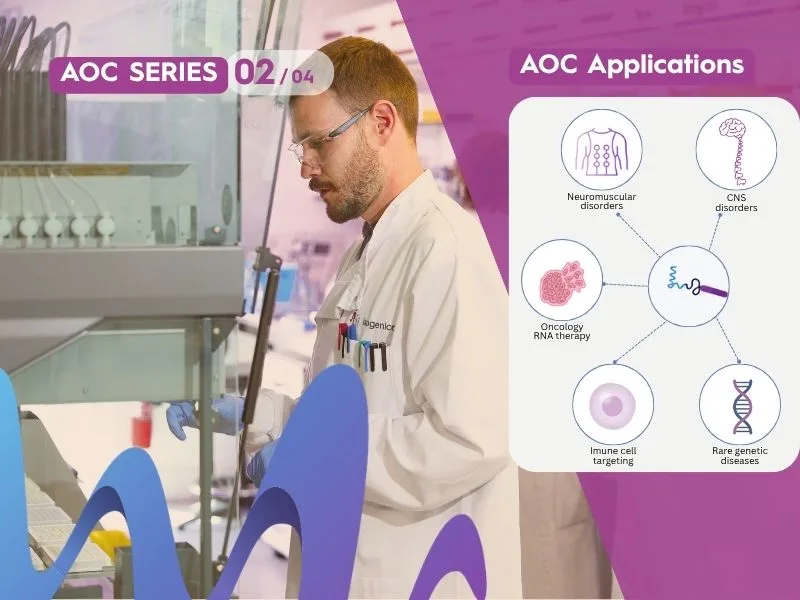
Rare genetic diseases, neuromuscular disorders, and central nervous system (CNS) pathologies remain therapeutic challenges. Many still lack effective treatments because they are difficult to reach with conventional modalities. In this context, two promising biotechnological approaches are converging: therapeutic antibodies and oligonucleotide-based medicines.
Therapeutic oligonucleotides, including small interfering RNA (siRNA), antisense oligonucleotides (ASOs), and splice-switching oligonucleotides (SSOs), provide a versatile class of medicines capable of modulating disease biology through a range of mechanisms. Many are designed to target genetic drivers previously considered “undruggable” (3), while others, such as CpG oligonucleotides, act by activating innate immune signaling pathways. A tangible example is nusinersen (Spinraza), an approved ASO for spinal muscular atrophy (4). They offer advantages as:
- Sequence selectivity
- Multiple mechanisms of action: RNA interference, RNase H recruitment, splicing and modulation)
- Rapid, programmable design
However, as Juliano (2016) summarized, “effective delivery of oligonucleotides… remains a major problem (3).” Efficiently transporting oligonucleotides into target cells outside the liver is still extremely challenging. Some barriers include:
- Poor extrahepatic biodistribution
- Low cellular uptake
- Extensive endosomal trapping
- Blood–brain barrier penetration
- Muscle tissue barriers
When it comes to AOCs, they provide receptor-mediated delivery. They enable specific cell populations to internalize genetic payloads through endocytosis while reducing off-target exposure.
How do AOCs differ from other targeted therapies?
Compared with other biological modalities, AOCs combine targeted delivery with the functional diversity of therapeutic oligonucleotides, giving them a distinct mechanism of action and therapeutic scope:
- Monoclonal antibodies (mAbs)
mAbs bind extracellular or cell-surface targets to block or activate signaling pathways. They are not designed to deliver intracellular payloads. mAbs have been highly successful in oncology, immunology, and inflammatory diseases, but their activity is generally limited to extracellular or surface-level protein interactions. - Antibody–drug conjugates (ADCs)
ADCs deliver small cytotoxic payloads into cells to induce cell death. Their primary application is oncology, where the goal is selective elimination of rapidly proliferating tumor cells. Accordingly, ADCs are primarily designed for targeted cytotoxicity (5). - AOCs
AOCs deliver therapeutic oligonucleotides into specific cell populations, enabling a range of intracellular mechanisms depending on the payload. These include RNA interference, RNAse H-mediated degradation, splice modulation, and immune receptor agonism. Rather than simply blocking extracellular signaling or inducing cell death, AOCs enable targeted modulation of intracellular biological pathways (1).
| Modality | Therapeutic payload | MoA | Main therapeutic scope |
| mAb | None (binding only) | Protein modulation | Surface-target diseases (oncology, immunology) |
| ADC | Cytotoxic drug | Cell killing | Mainly oncology |
| AOC | Therapeutic oligonucleotide | Gene regulation | Genetic, neuromuscular, and CNS diseases beyond the liver |
AOCs components
An AOC typically consists of three main components:
- Targeting ligand
This can be a full-length antibody, an antibody fragment (Fab, scFv), or a single-domain antibody such as a VHH. Its role is to recognize a specific cell-surface target and promote selective uptake of the conjugate into target cells through receptor-mediated internalization pathways. - Linker chemistry
The linker connects the targeting component to the oligonucleotide payload. Designing this component correctly is critical to ensure efficient and specific intracellular release of the oligonucleotide, for example through pH-sensitive or enzyme-cleavable systems. - Oligonucleotide payload
The oligonucleotide payload provides the biological activity of the conjugate. Payloads may include siRNAs, ASOs, splice-switching oligonucleotides (SSOs), immunostimulatory oligonucleotides such as CpG, or other oligonucleotide-based modalities. Depending on the payload, AOCs can modulate gene expression through mechanisms such as RNA interference (RNAi), RNase H-mediated degradation, splice modulation, or activate intracellular signaling pathways through mechanisms such as receptor agonism (3).
The targeting component provides cell-targeting specificity, while the oligonucleotide determines the resulting biological effect. This dual-layer precision is one of the defining strengths of the modality. VHH-based targeting approaches and their potential advantages are discussed in more detail below.
In the next article, we’ll explore how AOCs are constructed and review the therapeutic programmes driving interest in this rapidly evolving field.
References
- Li M, An H, Zhang J, Li W, Yu C & Wang L (2025). Advances in the pharmaceutical development of antibody-oligonucleotide conjugates. European Journal of Pharmaceutical Sciences, 215: 107292. doi:10.1016/j.ejps.2025.107292
- Dowdy SF (2023). Endosomal escape of RNA therapeutics: How do we solve this rate-limiting problem? RNA, 29(4): 396–401. doi:10.1261/rna.079507.122
- Roberts TC, Langer R & Wood MJA (2020). Advances in oligonucleotide drug delivery. Nat Rev Drug Discov, 19(10): 673–694. doi:10.1038/s41573-020-0075-7
- Ionis Pharmaceuticals, Inc (2016). SPINRAZATM (nusinersen) Approved in U.S. to Treat Broad Range of Patients with Spinal Muscular Atrophy. Available at: https://ir.ionis.com/news-releases/news-release-details/spinrazatm-nusinersen-approved-us-treat-broad-range-patients
- Beck A, Goetsch L, Dumontet C & Corvaïa N (2017). Strategies and challenges for the next generation of antibody–drug conjugates. Nat Rev Drug Discov, 16(5): 315–337. doi:10.1038/nrd.2016.268
Read More Research-Focused Blog Posts