
How Are Antibody-Oligonucleotide Conjugates Being Applied?
As the field matures, AOCs are being investigated across a growing number of therapeutic areas, reflecting increasing interest in targeted delivery platforms that extend beyond the liver.
Therapeutic approaches
AOC programs are being explored across a range of therapeutic areas where targeting oligonucleotide delivery could address important biological and delivery challenges. These include muscular and neuromuscular disorders, rare genetic diseases affecting organs such as the heart or kidney, central nervous system (CNS) disorders, ophthalmology, neurodegeneration, and selected oncology or immunology applications involving immunomodulatory oligonucleotides.
Some examples include:
- AOC 1001 (Avidity Biosciences)
A TfR1-targeting antibody conjugated to an siRNA designed to silence the DMPK gene in myotonic dystrophy type 1 (DM1). The program recently received FDA Breakthrough Therapy Designation.
- DYNE-101 (Dyne Therapeutics)
An ASO conjugated to a TfR1-targeting Fab fragment designed for muscle delivery and modulation of DMPK RNA processing in myotonic dystrophy type 1. - ABX-1100 (Aro Biotherapeutics)
A Centyrin-based targeting scaffold conjugated to an siRNA payload, using TfR1-mediated targeting approaches to support delivery in Pompe disease. - TAC-001 (Tallac Therapeutics)
A CD22-targeting antibody with a CpG oligonucleotide, an immunostimulatory payload that activates Toll-like receptor 9 (TLR9) signaling to stimulate B-cell responses in oncology settings.

Neuromuscular disorders

CNS disorders

Oncology RNA therapy

Immune cell targeting

Rare genetic diseases
Comparison with other delivery system
Several delivery strategies currently exist for oligonucleotide therapeutics, each with distinct advantages and limitations:
- Local administration
Intrathecal or intravitreal injections bypass biological barriers directly but generally limit treatment to specific anatomical compartments and often require invasive procedures. - Chemical modifications
Chemical modifications can improve oligonucleotide stability and pharmacokinetics, but do not fully solve the challenge of targeted cellular delivery. While these strategies have contributed substantially to the success of liver-directed oligonucleotide therapies, achieving efficient and selective delivery to many extrahepatic tissues remains challenging. - Lipid nanoparticles (LNPs)
Lipid nanoparticles (LNPs) are advanced delivery systems that use lipid-based structures to transport therapeutic molecules, such as mRNA, into cells. They have become a key technology in mRNA vaccines and emerging liver-targeted therapies because they can enable the systemic delivery of otherwise fragile molecules. However, after administration, many LNPs naturally accumulate in the liver and other organs of the reticuloendothelial system, highlighting both their effectiveness as delivery vehicles and the ongoing challenge of achieving precise tissue targeting (1), (2). - Viral vectors
Viral systems can achieve highly efficient intracellular delivery, but their use can be limited by concerns related to immunogenicity, manufacturing complexity, and limited dose control (3).
- GalNAc conjugates
GalNAc (N-acetylgalactosamine) is a targeted delivery strategy that has transformed liver-directed therapies, particularly for antisense oligonucleotides (ASOs) and small interfering RNAs (siRNAs). By exploiting the asialoglycoprotein receptor (ASGPR) expressed on hepatocytes, GalNAc conjugates enable efficient uptake into liver cells. However, this approach remains largely limited to hepatic delivery, restricting its broader application beyond the liver (4). - AOCs
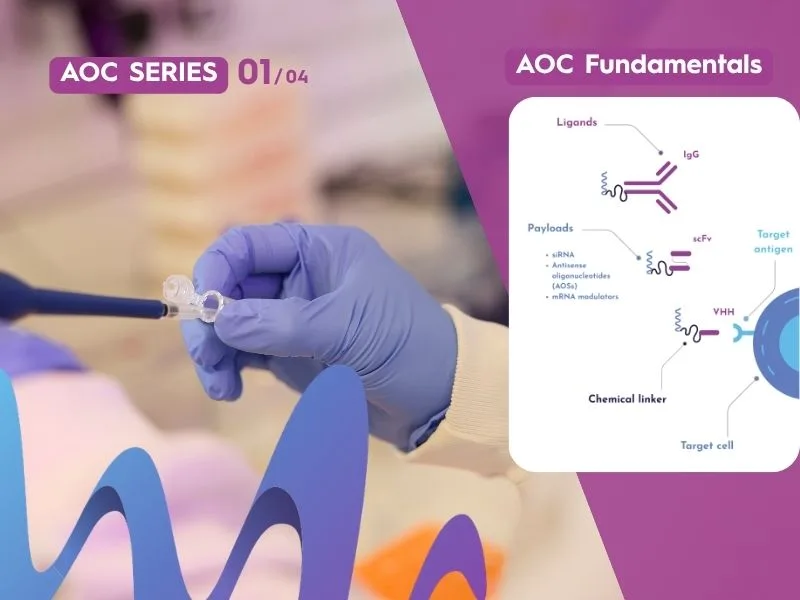
AOCs (antibody–oligonucleotide conjugates) represent an emerging approach that combines the targeting specificity of antibodies with the therapeutic potential of oligonucleotide medicines. By linking antibody-based targeting molecules, including full-length antibodies, antibody fragments, or VHHs, to oligonucleotide payloads, AOCs aim to overcome some of the limitations of existing delivery platforms. In particular, they offer the potential to extend targeted delivery beyond the liver and improve intracellular delivery following receptor-mediated uptake.

Growing clinical momentum
Several AOCs have already advanced into clinical development, demonstrating the growing interest in targeted oligonucleotide delivery across multiple therapeutic areas.
Pompe disease (muscle glycogen accumulation)
- ABX-1100 (Aro Biotherapeutics) uses a TfR1 (CD71)-targeting Centyrin conjugated to an siRNA payload targeting GYS1 for Pompe disease (5), demonstrating that alternative targeting scaffolds can also be adapted for oligonucleotide delivery.
Myotonic dystrophy type 1 (DM1)
- Delpacibart etedesiran (AOC 1001, Avidity Biosciences). Combines an anti-TfR1 (CD71) antibody with an siRNA payload designed to reduce DMPK expression. The program recently received FDA Breakthrough Therapy Designation (3).
- DYNE-101 (Dyne Therapeutics). Uses an ASO targeting DMPK conjugated to an TfR1-targeting Fab fragment to enable muscle-directed delivery (6).
Other neuromuscular disorders
Additional oligonucleotide conjugates are being explored for Duchenne muscular dystrophy (DMD), Becker muscular dystrophy, and related disorders, including strategies focused on dystrophin splicing correction or toxic RNA suppression.
Immuno-oncology
TAC-001 (Tallac Therapeutics) combines an anti-CD22 antibody conjugated with a CpG oligonucleotide designed to activate Toll-like receptor 9 (TLR9) signaling to promote B-cell activation and antitumor immune responses. This program illustrates the potential of antibody-oligonucleotide conjugates beyond gene modulation, extending into targeted immune activation (7).
Many current programs leverage transferrin receptor (TfR1/CD71) targeting, particularly for muscle delivery, while CNS-focused approaches are increasingly exploring neuronal transport receptors to improve access to the nervous system.
Together, these programs demonstrate that AOCs are evolving into versatile delivery platforms capable of supporting a wide range of therapeutic oligonucleotide modalities and disease applications. As interest in the field grows, attention is increasingly turning to one critical question: what makes an effective targeting ligand? In the next article, we’ll explore why single-domain antibodies (VHHs) are emerging as a particularly attractive format for AOC development.
References
- Juliano RL & Akhtar S (1992). Liposomes as a drug delivery system for antisense oligonucleotides. Antisense Res Dev, 2(2): 165–176. doi:10.1089/ard.1992.2.165
- Wisse E, Jacobs F, Topal B, Frederik P & De Geest B (2008). The size of endothelial fenestrae in human liver sinusoids: implications for hepatocyte-directed gene transfer. Gene Ther. 15(17): 1193–1199. doi:10.1038/gt.2008.60
- Bulaklak K & Gersbach CA (2020). The once and future gene therapy. Nat Commun, 11(1): 5820. doi:10.1038/s41467-020-19505-2
- Prakash TP, Graham MJ, Yu J, Carty R, Low A, Chappell A, et al (2014). Targeted delivery of antisense oligonucleotides to hepatocytes using triantennary N-acetyl galactosamine improves potency 10-fold in mice. Nucleic Acids Res, 42(13): 8796–8807. doi:10.1093/nar/gku531
- Aro Biotherapeutics (2022). Aro Biotherapeutics Receives FDA Orphan Drug Designation for ABX1100 for the Treatment of Pompe Disease. Available at: https://www.arobiotx.com/aro-receives-fda-orphan-drug-designation-for-abx1100
- Dyne Therapeutics (no date). DYNE-101 an investigational therapeutic for people living with myotonic dystrophy type 1 (DM1). Available at: https://www.dyne-tx.com/dyne-101-for-dm1/
- vasundhara (2022). Tallac Therapeutics doses first subject in Phase I/II solid tumour trial. Clinical Trials Arena. Available at: https://www.clinicaltrialsarena.com/news/tallac-doses-subject-phase-i-ii-solid-tumour-trial
Read More Research-Focused Blog Posts