
VHH Affinity Maturation and Engineering

Isogenica provides dedicated affinity maturation and antibody engineering programmes to optimise VHH leads for potency, developability, and integration into complex therapeutic formats — including multi-specific antibodies and payload conjugation (for example: as antibody-drug conjugates (ADCs), antibody-oligonucleotide conjugates (AOCs) or targeted lipid nanoparticles (LNPs)).

Scientific & Therapeutic Context

About VHH Affinity Maturation and Engineering

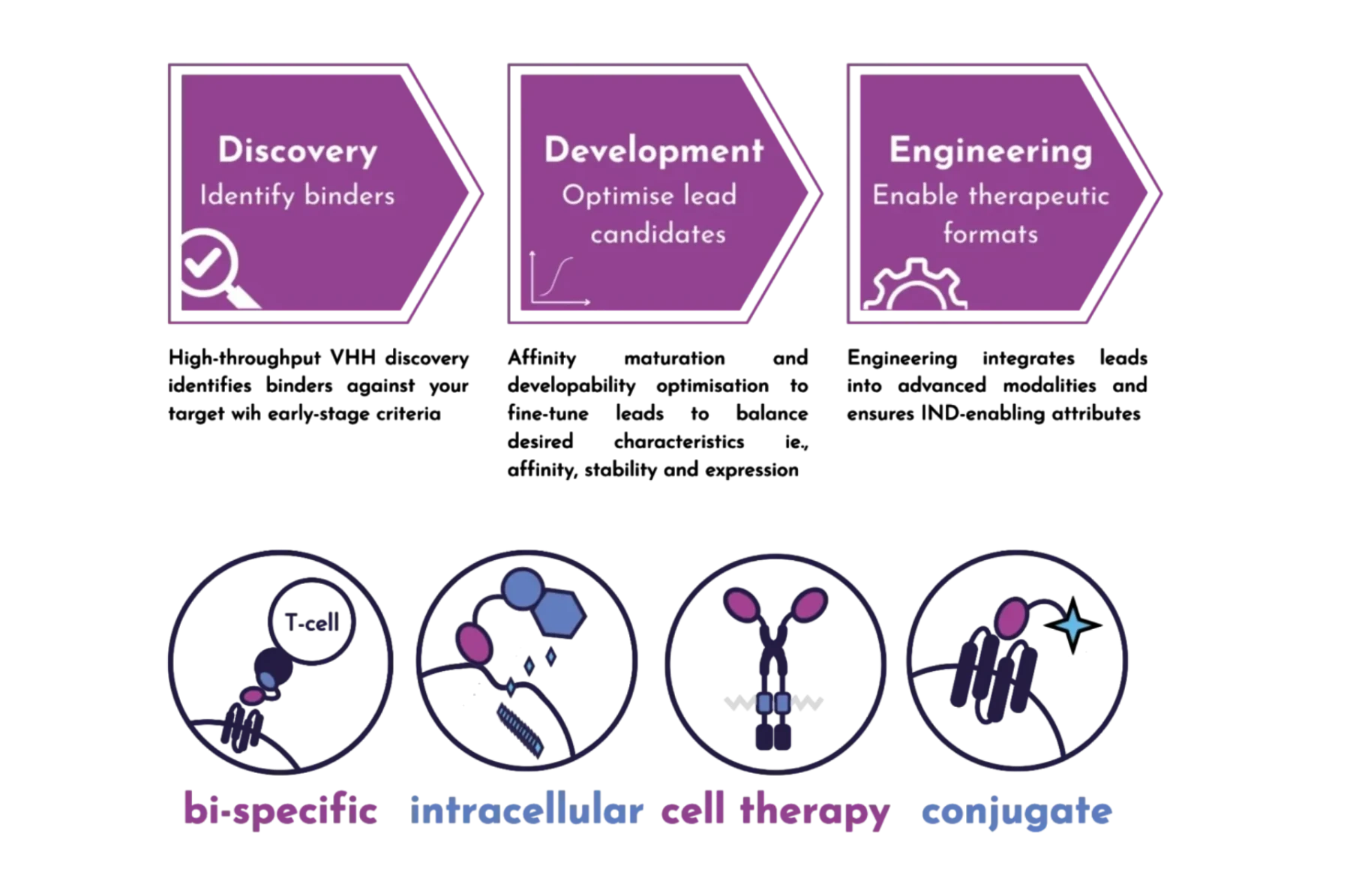
Discovery identifies what can bind (within a range of specific early criteria). Development refines and selects lead molecules into developable candidates. Engineering determines which can become an investigational new drug (IND). As antibody programmes progress, lead candidates must meet increasingly stringent requirements for affinity, specificity, stability, manufacturability, and downstream format compatibility. This is particularly true for advanced modalities such as multi-specifics, T-cell engagers, ADCs, and engineered receptor formats, where geometry and molecular behaviour are as critical as binding strength. For many programmes, affinity maturation and/or engineering therefore represent a distinct phase of work, requiring different tools, expertise, and decision frameworks beyond initial discovery. This stage focuses on improving both performance and developability, ensuring that promising molecules can progress toward viable therapeutic formats. Isogenica supports these programmes, either as standalone projects or as a continuation of earlier VHH Discovery – with workflows designed to enhance molecular performance while maintaining developability, enabling efficient progression from early leads to IND candidates.

How Isogenica Approaches Affinity Maturation & Engineering

Isogenica applies a data-driven, format-aware approach to VHH optimization, recognising that engineering often supports downstream therapeutic formats as well as improved binding performance. Key capabilities include:

  • Targeted affinity maturation using focused libraries and rational design
  • Sequence optimisation to improve stability, solubility, and expression
  • Humanisation strategies to reduce immunogenic risk while retaining function
  • Engineering of VHHs into bi-specific and multi-specific architectures
  • C-terminal cysteine conjugation for site-specific payload attachment
  • Early consideration of downstream requirements, including half-life extension and manufacturability

Because VHHs are single, compact domains, sequence changes can be explored efficiently while maintaining clear links between mutation, structure, and function. This supports rapid, rational optimisation across both molecular performance and final format requirements. These approaches can be supported by iterative cycles of design, experimental validation, and refinement that connect sequence variation to functional and biophysical outcomes, enabling informed prioritization throughout optimisation.
Why VHH Antibodies?

VHH single-domain antibodies offer unique advantages during affinity maturation and engineering:

  • Mutations are easier to interpret and control within a single binding domain
  • High tolerance for sequence diversification
  • Reduced risk of mispairing compared to multi-chain antibodies
  • Excellent compatibility with fusion, multi-specific, and engineered formats

These properties allow optimisation programmes to move quickly while maintaining confidence in developability and downstream performance.

Key advantages

  • Dedicated affinity maturation as a standalone service
  • Rational and library-based optimisation strategies
  • Humanisation workflows designed specifically for VHHs
  • Format-aware engineering for bi-specifics and complex constructs
  • Preservation of developability alongside affinity gains
  • Seamless transition into downstream engineering and CMC planning

Bi-Specifics and Complex Formats

Bi-specific antibodies and related multi-domain constructs are a major focus of Isogenica’s engineering programmes. These advanced modalities place additional demands on antibody design, where geometry, stability, and functional balance are critical.
VHHs are particularly well suited to these formats due to their:

  • Small size and modularity
  • Independent folding and binding behaviour
  • Flexibility in linker design and domain orientation

Isogenica supports the engineering and optimisation of VHHs specifically for inclusion in bi-specific formats, ensuring that affinity, geometry, and stability are balanced across all binding domains.  

C-terminal cysteine conjugation for site-specific payload attachment

At Isogenica, we have applied C-terminal cysteine conjugation as a site-specific strategy for functionalisation of VHHs from our synthetic libraries. This approach introduces a defined cysteine at the C-terminus, providing a controlled conjugation handle that enables attachment of diverse payloads, including lipid nanoparticles and oligonucleotides.
ADC drug discovery
Cysteines are highly reactive, and when introduced into proteins they can present risks such as unintended disulfide formation, misfolding, or aggregation. This is particularly relevant in the context of Isogenica’s scaffold, which contains a single native disulfide bond that supports its efficient folding and robust expression. In our VHH formats, the addition of a C-terminal cysteine has been evaluated within screening workflows to assess compatibility with library-derived sequences. Across these systems, VHH functionality has been retained, enabling reliable screening and progression of modified constructs. This supports the use of VHHs from our libraries in conjugation strategies requiring site-specific attachment of functional payloads, enabling downstream applications that depend on modular and controlled bioconjugation.  

Isogenica’s

VHH in bi-specifics

RESOURCES

VHH Humanisation

VHH Humanisation

VHH humanisation can be a challenge. Here, we compare two methods – safe-but-slow rational humanisation and fast-but-risky CDR grafting. We also explore the impact of synthetic versus immune-derived frameworks.

read more

Optimise Your VHH Lead for the Next Stage

If you have a VHH lead that requires higher affinity, improved developability, or integration into a engineered format, Isogenica can design and deliver a tailored optimisation programme.  


Contact us