
VHH Affinity Maturation and Engineering
Scientific & Therapeutic Context
About VHH Affinity Maturation and Engineering
How Isogenica Approaches Affinity Maturation & Engineering
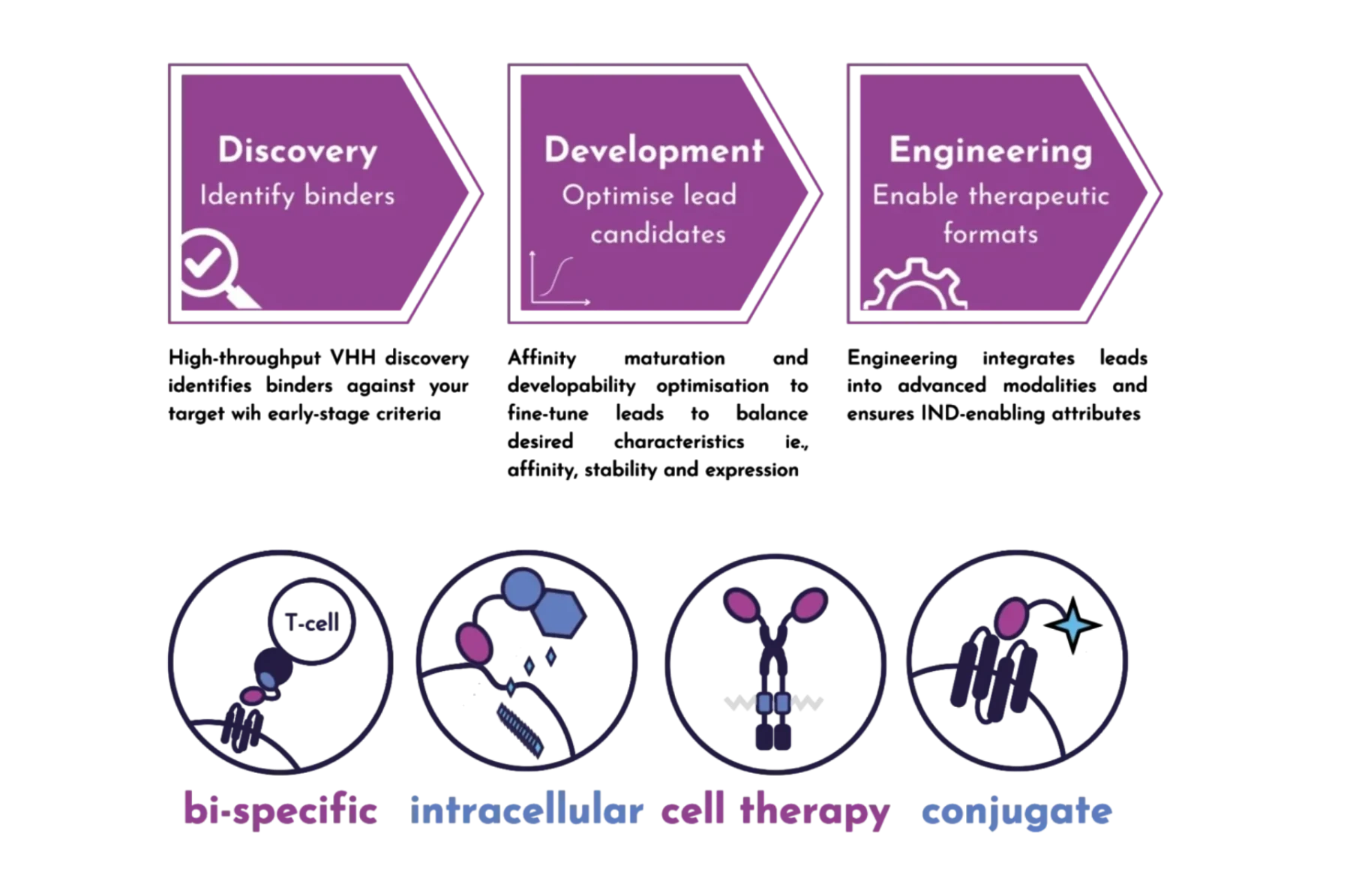
- Targeted affinity maturation using focused libraries and rational design
- Sequence optimisation to improve stability, solubility, and expression
- Humanisation strategies to reduce immunogenic risk while retaining function
- Engineering of VHHs into bi-specific and multi-specific architectures
- C-terminal cysteine conjugation for site-specific payload attachment
- Early consideration of downstream requirements, including half-life extension and manufacturability
Because VHHs are single, compact domains, sequence changes can be explored efficiently while maintaining clear links between mutation, structure, and function. This supports rapid, rational optimisation across both molecular performance and final format requirements. These approaches can be supported by iterative cycles of design, experimental validation, and refinement that connect sequence variation to functional and biophysical outcomes, enabling informed prioritization throughout optimisation.
Could a smaller antibody format improve your lead optimisation strategy?
Why VHH Antibodies?
- Mutations are easier to interpret and control within a single binding domain
- High tolerance for sequence diversification
- Reduced risk of mispairing compared to multi-chain antibodies
- Excellent compatibility with fusion, multi-specific, and engineered formats
These properties allow optimisation programmes to move quickly while maintaining confidence in developability and downstream performance.
Key advantages
- Dedicated affinity maturation as a standalone service
- Rational and library-based optimisation strategies
- Humanisation workflows designed specifically for VHHs
- Format-aware engineering for bi-specifics and complex constructs
- Preservation of developability alongside affinity gains
- Seamless transition into downstream engineering and CMC planning
Bi-Specifics and Complex Formats

- Small size and modularity
- Independent folding and binding behaviour
- Flexibility in linker design and domain orientation
Isogenica supports the engineering and optimisation of VHHs specifically for inclusion in bi-specific formats, ensuring that affinity, geometry, and stability are balanced across all binding domains.
C-terminal cysteine conjugation for site-specific payload attachment

Isogenica’s
VHH in bi-specifics
RESOURCES

2-for-1 VHH antibody engineering
When a partner needed VHH antibody engineering fast, we developed a method to humanise and affinity mature the antibodies in a single step.

VHH Humanisation
VHH humanisation can be a challenge. Here, we compare two methods – safe-but-slow rational humanisation and fast-but-risky CDR grafting. We also explore the impact of synthetic versus immune-derived frameworks.
Optimise Your VHH Lead for the Next Stage
If you have a VHH lead that requires higher affinity, improved developability, or integration into a engineered format, Isogenica can design and deliver a tailored optimisation programme.