
Why VHHs Are Attractive Targeting Ligands for Antibody-Oligonucleotide Conjugates
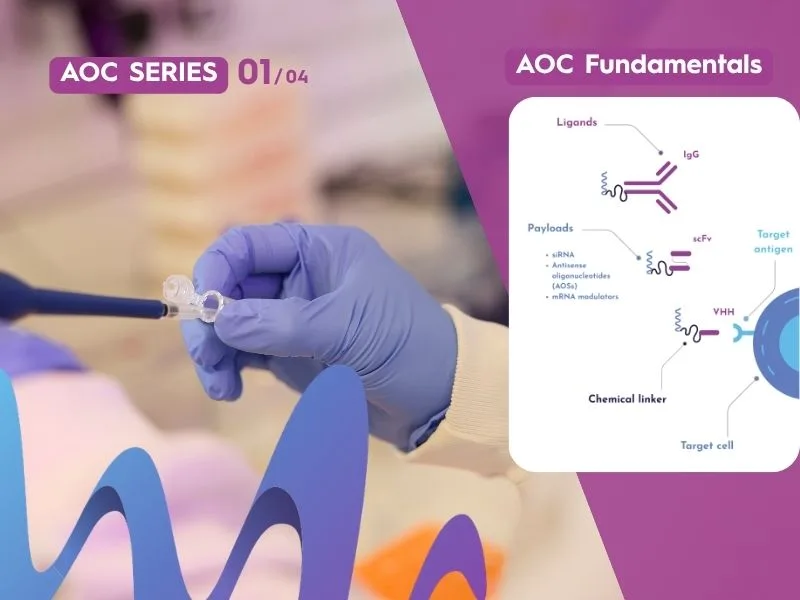
The therapeutic activity of an AOC depends not only on its oligonucleotide payload but also on the targeting ligand that delivers it to the appropriate cells. Selecting the right targeting molecule is therefore a critical part of AOC design.
Single-domain antibodies, also known as VHHs or nanobodies, have emerged as particularly attractive targeting scaffolds because of their compact size, stability and engineering flexibility.
How does a VHH-enabled AOC work?
The mechanism of action of an AOC typically follows four main steps:
1. Target recognition
The antibody, antibody fragment or VHH binds to a specific cell-surface receptor or antigen, such as transferrin receptor 1 (TfR1/CD71), low-density lipoprotein 1 (LRP1), or other receptors associated with tissue-selective uptake.
2. Internalization
Receptor binding can promote receptor-mediated endocytosis, resulting in uptake of the conjugate into intracellular endosomal compartments.
3. Oligonucleotide release
Following internalization, the conjugate undergoes intracellular trafficking and processing. Linker and conjugate design can influence payload availability through mechanisms such as chemical cleavage, enzymatic processing, or other intracellular release strategies. Achieving productive delivery of oligonucleotide payloads to their site of action, including overcoming endosomal barriers where required, remains a key challenge in AOC development.
4. Payload-driven biological activity
Following successful intracellular delivery, the oligonucleotide payload exerts its biological effect through a mechanism determined by its design. These mechanisms may include RNA interference through RISC pathway engagement (siRNA), RNase H-mediated degradation (ASOs), splice modulation, or immune pathway activation for immunostimulatory oligonucleotides.

Intracellular delivery remains a challenge
A major remaining bottleneck in AOC development is productive intracellular delivery, particularly endosomal escape. Following receptor-mediated uptake, only a limited proportion of internalized oligonucleotide may reach the appropriate intracellular compartment required for activity. Significant efforts are therefore focused on improving this step through strategies including endosomolytic approaches, optimized linker chemistries, and hybrid delivery systems (1).
Despite these challenges, targeted delivery through AOCs has the potential to increase oligonucleotide exposure within selected cell populations while reducing distribution to non-target tissues. Continued advances in conjugate design, intracellular trafficking, and payload optimization will be important for unlocking the full therapeutic potential of the modality.
Why VHHs?
Single-domain antibodies (VHHs, ~15 kDa) are compact and highly stable antibody fragments with properties that can support tissue penetration and access to epitopes that may be challenging for larger antibody formats. Their simple single-domain architecture also makes VHHs highly amenable to genetic engineering, enabling flexible incorporation of conjugation handles and other modifications for AOC design.
VHHs advantages for targeting and delivery applications, summarized:
- Small size (~15 kDa). Their compact size can facilitate improved tissue penetration, including access to dense tissues such as solid tumors and muscle, although tissue distribution remains dependent on additional molecular properties and delivery context.
- High structural stability. VHHs are highly resistant to harsh conditions, including pH and temperature changes, improving their pharmacological robustness and formulation flexibility.
- Reduced steric hindrance. Their small footprint allows access to cryptic or sterically restricted epitopes that may be inaccessible to full-length IgGs. Multiple VHHs can also bind spatially constrained regions more effectively.
- Modular engineering. VHHs are highly modular scaffolds that can be engineered through framework optimization, humanization, site-specific conjugation handles, fusion partners, or other genetic modifications. This flexibility supports the design of AOC architectures with tailored targeting and pharmacokinetic properties.
Together these properties make VHH attractive targeting scaffolds for AOCs, enabling compact conjugate designs with flexible engineering options and tunable pharmacokinetic characteristics.
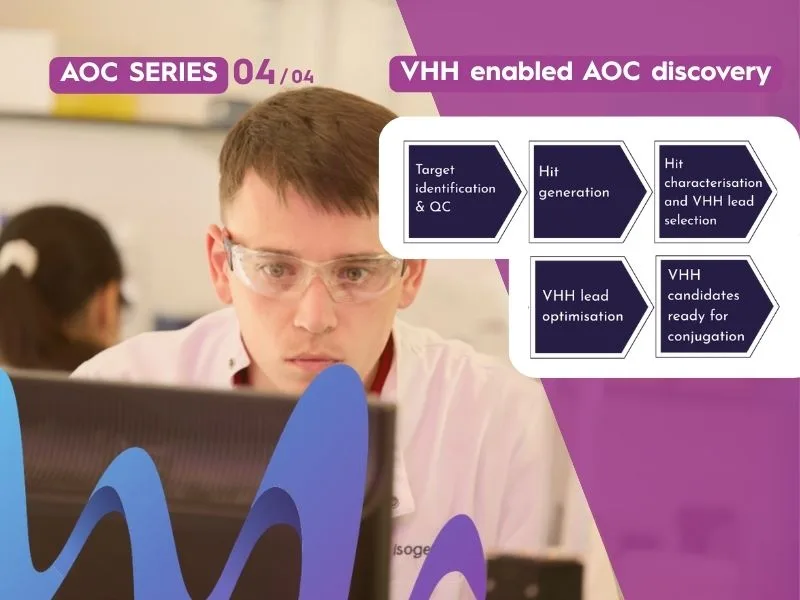
While VHHs offer an attractive foundation for targeted oligonucleotide delivery, identifying high-quality targeting ligands and optimizing them for conjugation remains a discovery challenge. In the final article of this series, we’ll explore how Isogenica’s synthetic VHH libraries and in vitro selection technologies support the discovery and engineering of next-generation AOCs.
References
- Juliano RL (2016). The delivery of therapeutic oligonucleotides. Nucleic Acids Res, 44(14): 6518–6548. doi:10.1093/nar/gkw236
Read More Research-Focused Blog Posts