
Accelerating VHH-enabled Antibody-Oligonucleotide Conjugates Discovery
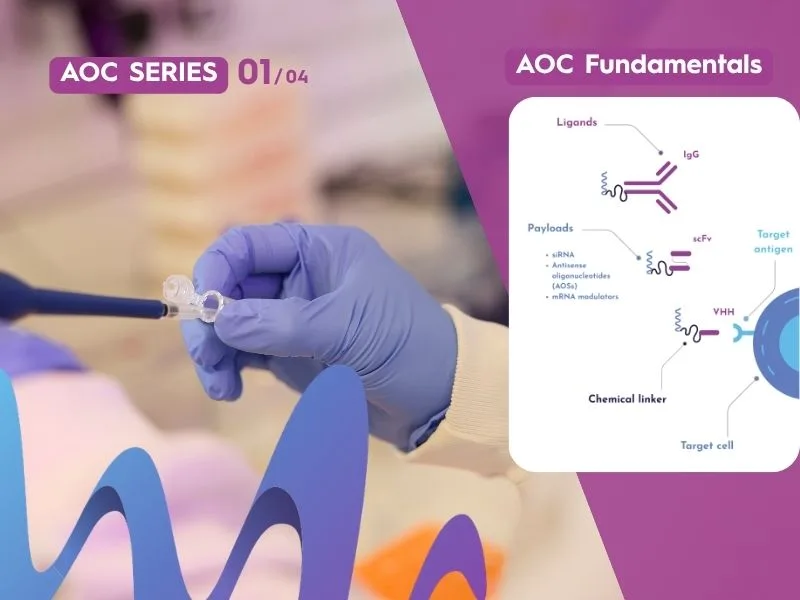
Developing an effective AOC requires more than identifying a receptor. High-quality targeting ligands must combine specificity, internalisation, developability and compatibility with conjugation strategies
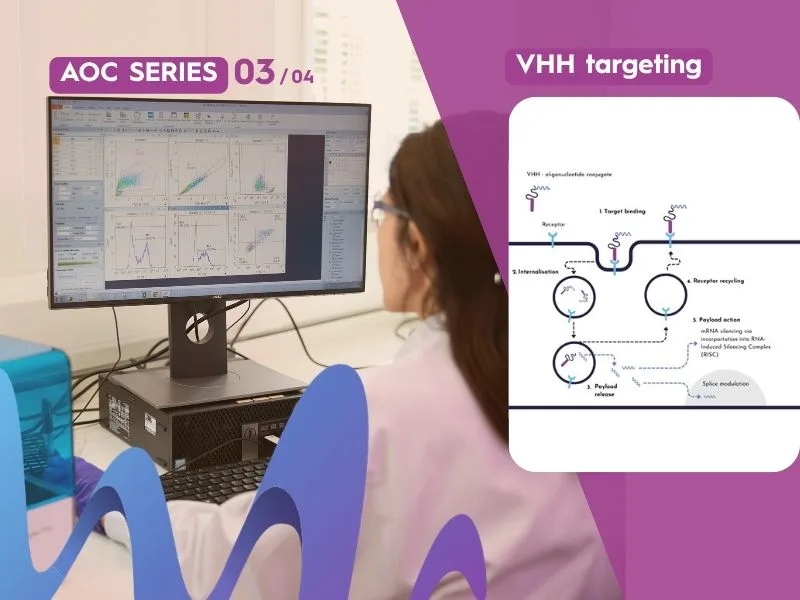
VHH-based platforms can accelerate and de-risk AOC discovery programs through higher-diversity libraries, fully in vitro selection, functional screening, site-specific conjugation, and simpler production systems. In this article, we explain how and why.

Ultra-diverse synthetic libraries
The diversity of synthetic VHH libraries can significantly exceed most traditional immune libraries. For instance, Isogenica’s Colibra® VHH libraries reach diversities of between 1010–1013 variants. This maximizes the probability of identifying high-quality and diverse binders against difficult or unconventional targets. Because the libraries are synthetic, structure-guided, and humanized, they avoid animal immune biases while supporting smoother downstream manufacturability.
Fully in vitro selection
This technology can operate entirely cell free, enabling rapid and scalable ligand discovery without the transformation bottlenecks associated with bacterial display systems. Library size is effectively unrestricted, allowing highly flexible and accelerated selection campaigns. It is also possible to integrate next-generation sequencing (NGS) throughout the process to monitor enrichment in real time and identify rare but valuable clonotypes.
In our experience at Isogenica, candidate identification can often be achieved in roughly half the time required by conventional approaches and either phage or CIS is selectively offered based on project requirements.
Functional screening and developability assessment
Beyond binder selection, this platform performs functional cellular assays to confirm receptor engagement, internalization, and downstream activity. Developability is evaluated early through sequence analysis and biophysical characterization, including aggregation risk, expression behavior, and molecular stability. This helps reduce downstream optimization burdens and minimizes late-stage surprises.
Site-specific conjugation strategies
The single-domain architecture of VHHs makes them highly amenable to genetic engineering, allowing the incorporation of site-specific conjugation handles with relative ease, with one example being the addition of a C-terminal cysteine. This can support the generation of more uniform conjugates for more reproducible manufacturing and downstream characterisation.
Scalable production capabilities
VHHs can be efficiently produced in bacterial, yeast or CHO-based systems, supporting straightforward scale-up from discovery through preclinical and clinical manufacturing. We also support half-life extension strategies, including PEGylation, albumin binding or Fc fusion formats, depending on project requirements.

Ultra-diverse synthetic libraries
The diversity of synthetic VHH libraries can significantly exceed most traditional immune libraries. For instance, Isogenica’s Colibra® VHH libraries reach diversities of between 1010–1013 variants. This maximizes the probability of identifying high-quality and diverse binders against difficult or unconventional targets. Because the libraries are synthetic, structure-guided, and humanized, they avoid animal immune biases while supporting smoother downstream manufacturability.
Fully in vitro selection
This technology can operate entirely cell free, enabling rapid and scalable ligand discovery without the transformation bottlenecks associated with bacterial display systems. Library size is effectively unrestricted, allowing highly flexible and accelerated selection campaigns. It is also possible to integrate next-generation sequencing (NGS) throughout the process to monitor enrichment in real time and identify rare but valuable clonotypes.
In our experience at Isogenica, candidate identification can often be achieved in roughly half the time required by conventional approaches and either phage or CIS is selectively offered based on project requirements.
Functional screening and developability assessment
Beyond binder selection, this platform performs functional cellular assays to confirm receptor engagement, internalization, and downstream activity. Developability is evaluated early through sequence analysis and biophysical characterization, including aggregation risk, expression behavior, and molecular stability. This helps reduce downstream optimization burdens and minimizes late-stage surprises.
Site-specific conjugation strategies
The single-domain architecture of VHHs makes them highly amenable to genetic engineering, allowing the incorporation of site-specific conjugation handles with relative ease, with one example being the addition of a C-terminal cysteine. This can support the generation of more uniform conjugates for more reproducible manufacturing and downstream characterisation.
Isogenica VHH platform
| Attribute | Isogenica advantage | Benefit for partners |
| Library diversity | Ultra-high diversity (1010–1013) synthetic humanized VHH libraries | Greater epitope coverage and higher success probability against difficult targets |
| Selection platform | Fully in vitro Phage or CIS-Display with rapid cycles and NGS-enabled multiplex screening | Faster, controlled discovery workflows with reduced technical risk |
| Candidate selection | Native antigen and live-cell screening with precise counterselection strategies | More biologically relevant hits and improved translational predictability |
| Developability | Humanized frameworks plus early biophysical assessment | Optimized leads with lower downstream engineering burden |
| Discovery speed | Automation, parallel panning, and integrated NGS workflows | Faster progression toward clinical candidates while reducing cost and resource use |
| Collaborative model | Transparent partnership structure with continuous reporting and rapid iteration | Greater visibility, flexibility, and reduced project uncertainty |
Conclusion
VHH-enabled AOCs represent a promising solution for targeted RNA therapeutic delivery, overcoming many of the limitations associated with traditional delivery platforms. Isogenica sits at the intersection of this technological convergence: our synthetic VHH libraries and phage or CIS-Display platforms accelerate the discovery and optimization of customized AOCs for challenging therapeutic applications.
By combining ultra-diverse synthetic libraries, rapid in vitro selection, and developability-focused screening, we help reduce discovery timelines from years to months while improving the manufacturability and quality of lead candidates.
If your program involves difficult targets or extrahepatic delivery challenges, we invite you to speak with our scientific team. Schedule a discovery call to explore how Isogenica’s platform can accelerate your AOC strategy.
Read More Research-Focused Blog Posts